
Padel vs Tennis: The 7 Key Differences Every Player Should Know
From court walls to undershand serves, discover the 7 game-changing differences that separate padel’s social speed from tennis’s classic power.
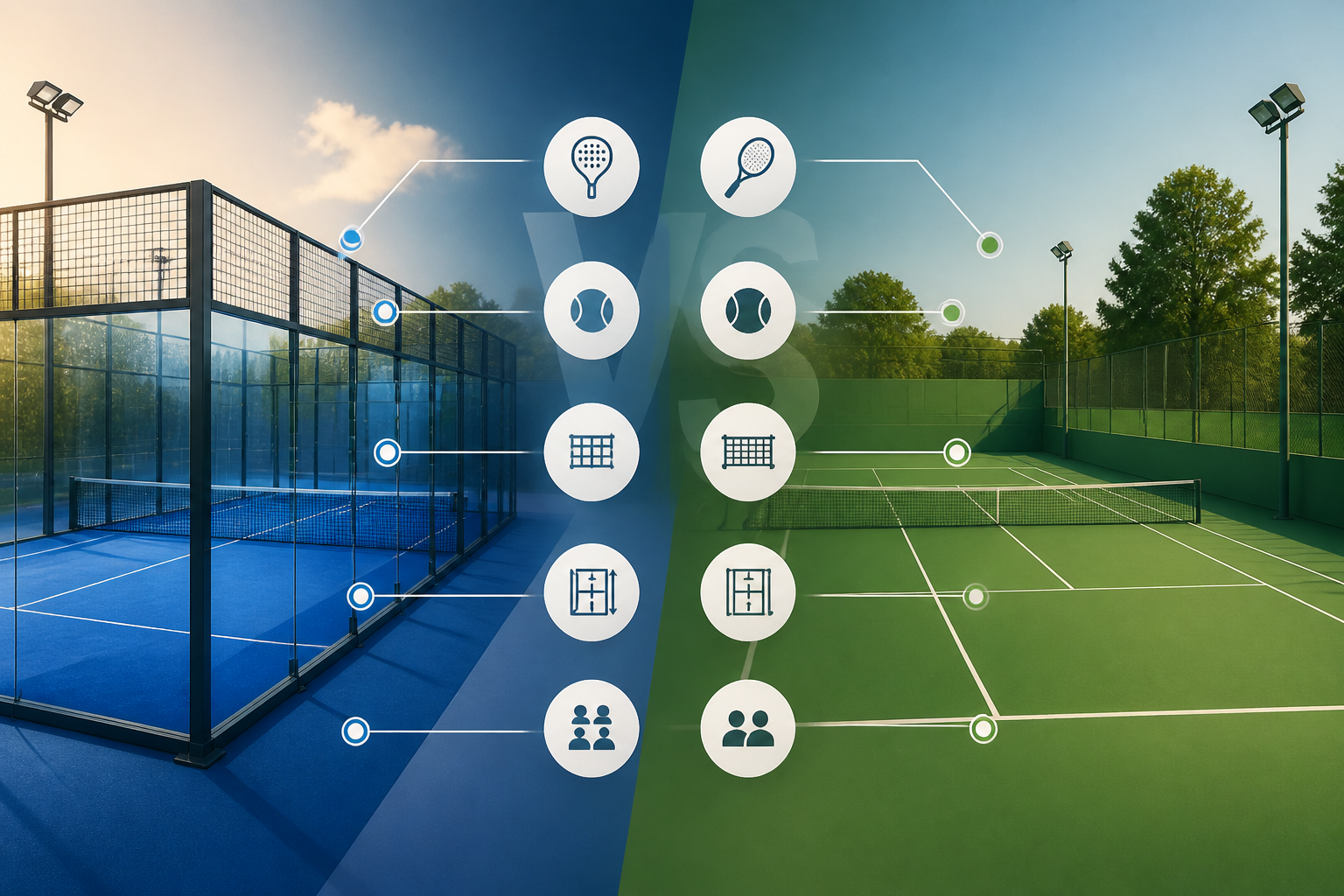
For decades, tennis has reigned supreme as the quintessential racket sport in the UK. Walk into any local park or sports club from Putney to Preston, and you’ll find the familiar green asphalt courts. However, a revolution is sweeping across the country. Padel, often described as a mix between tennis and squash, is currently the world's fastest-growing sport, and for good reason. While the transition from the court to the "cage" might look seamless to the untrained eye, the nuances are profound. Whether you are a regular at your local LTA-affiliated tennis club looking to try something new, or a complete novice, understanding these seven key differences is essential for mastering the 20x10 metre arena.
1. The Weapon of Choice: Racket vs Padel
In tennis, your tool is a stringed racket—usually something like the Babolat Pure Drive or a Wilson Pro Staff—designed for tension, snap, and power. Padel uses a "bat" or "paddle." These are solid, stringless structures usually made from carbon fibre or glass fibre with an EVA foam core.
If you swing a padel racket like a tennis racket, you’ll likely find the ball flying uncontrollably. Padel rackets are shorter and heavier. Brands like Bullpadel and Nox categorise their rackets by shape:
* Round: Higher control, large sweet spot.
* Teardrop: Balanced power and control.
* Diamond: High balance, designed for aggressive power (like the Head Delta series).
Pro Tip: If you’re transitioning from tennis, start with a round or teardrop racket. The shorter handle requires a much more compact swing than the long, flowing strokes used in tennis.
2. The Court: The Glass is Your Friend
The most obvious difference is the enclosure. A tennis court is "infinite"—if the ball passes you, the point is over. In padel, the 10m x 20m court is surrounded by glass walls and metallic fencing.
In tennis, defenders try to stay near the baseline to retrieve deep balls. In padel, you often let the ball pass you, hit the back glass, and then play it on the rebound. This makes the game much more tactical and allows for longer rallies. You aren't just playing against an opponent; you are playing with the geometry of the "cage."
3. The Serve: Underarm vs Overarm
In tennis, the serve is a primary weapon. Icons like Nick Kyrgios or Pete Sampras built their careers on high-velocity, overhead serves. It is often the most difficult skill for a beginner to master.
In padel, the serve is strictly underarm. The ball must be hit at or below waist height after a single bounce behind the service line. While you can still apply significant slice using a racket like the Adidas Metalbone, the serve in padel is rarely an "ace" machine. Instead, it is a tactical tool used to force a weak return, allowing the serving team to rush the net and take a dominant position.
4. Scoring and the "Golden Point"
While both sports generally use the 15, 30, 40, Game scoring system, the way a set concludes can differ. In professional tennis, you must win a game by two clear points (Deuce/Advantage).
In many padel circuits—and increasingly in UK social play to keep court rotations moving—the "Golden Point" (Punto de Oro) is used. At 40-40, the receiving team chooses which side to receive from, and the winner of that single point wins the game. It adds a level of high-stakes "sudden death" pressure that you rarely feel in a casual Sunday morning tennis doubles match.
5. Movement and Positioning: The Net is King
In tennis, especially at the amateur level, many players are comfortable as "baseliners," trading groundstrokes from the back of the court. In padel, the baseline is a place of transition or defense.
The goal in padel is to "take the net" and stay there. Because the court is smaller, the angles are sharper. You work with your partner as a unit—if one moves up, the other moves up. If you see a professional match on the World Padel Tour, you’ll notice players spend 80% of the point within three metres of the net. In the UK, where we often play on slower, grittier "sand-dressed" synthetic turf, the ability to control the net with volleys and "Bandejas" (a specific padel overhead) is the difference between a winner and a loser.
6. The Ball: Look-alikes, Not Twin-alikes
At a glance, a padel ball looks identical to a tennis ball. However, swap them and you’ll feel the difference immediately. Padel balls, such as the Head Padel Pro S or the Wilson X3, have lower internal pressure.
* Tennis balls: High pressure, designed to bounce high and travel fast through the air.
* Padel balls: Slightly smaller and significantly less "bouncy."
Using a tennis ball on a padel court makes the game nearly impossible to play tactically; the ball flies off the back glass too fast, making it impossible to retrieve. Conversely, using a padel ball for tennis would feel like hitting a lead weight that won't reach the net.
7. The "Patience" Factor: Power is a Trap
This is the biggest hurdle for high-level tennis players switching to padel. In tennis, if you have a short ball, you "kill" it with a flat, powerful winner. In padel, if you hit the ball too hard without the right angle, it will bounce off the back glass and come straight back to your opponent, leaving you out of position.
Padel is a game of "chess with movement." It rewards the lob over the smash. You win points by forcing your opponents into a mistake or by finding a pocket of space, rather than by sheer velocity. This is why padel is often seen as more inclusive; a 60-year-old with great tactical placement can easily beat a 25-year-old athlete who only knows how to hit the ball hard.
Summary Table: Padel vs Tennis
| Feature | Padel | Tennis |
| :--- | :--- | :--- |
| Service | Underarm (below waist) | Overarm |
| Racket | Solid/Carbon (no strings) | Stringed |
| Walls | Part of the game | Out of bounds |
| Court Size | 10m x 20m | 10.97m x 23.77m (Doubles) |
| Focus | Tactics and Rallies | Power and Precision |
| Primary Shot | Volley / Bandeja / Lob | Groundstrokes / Serve |
Key Takeaway for UK Players
The UK is currently seeing a massive investment in padel infrastructure, with clubs like Padel Social Club and Soul Padel opening sites across the country. If you are a tennis player making the jump, my best advice is to leave your ego at the gate.
Stop trying to hit winners on every ball. Invest in a pair of padel-specific shoes (the herringbone sole pattern on Asics or Babolat padel shoes is vital for grip on the sandy turf), and focus on your lobs. In tennis, a lob is a desperate defensive move; in padel, it is an attacking masterpiece. Embrace the glass, shorten your backswing, and you’ll find that padel isn't just a different sport—it’s a social, tactical, and addictive evolution of the racket game we love.
By PadelHub Editors · 04/06/2026