
Padel Scoring and Rules Explained (2026 Edition)
Master the court with this 2026 guide to Padel’s unique scoring, simplified rules, and the essential strategies you need to win your next match.
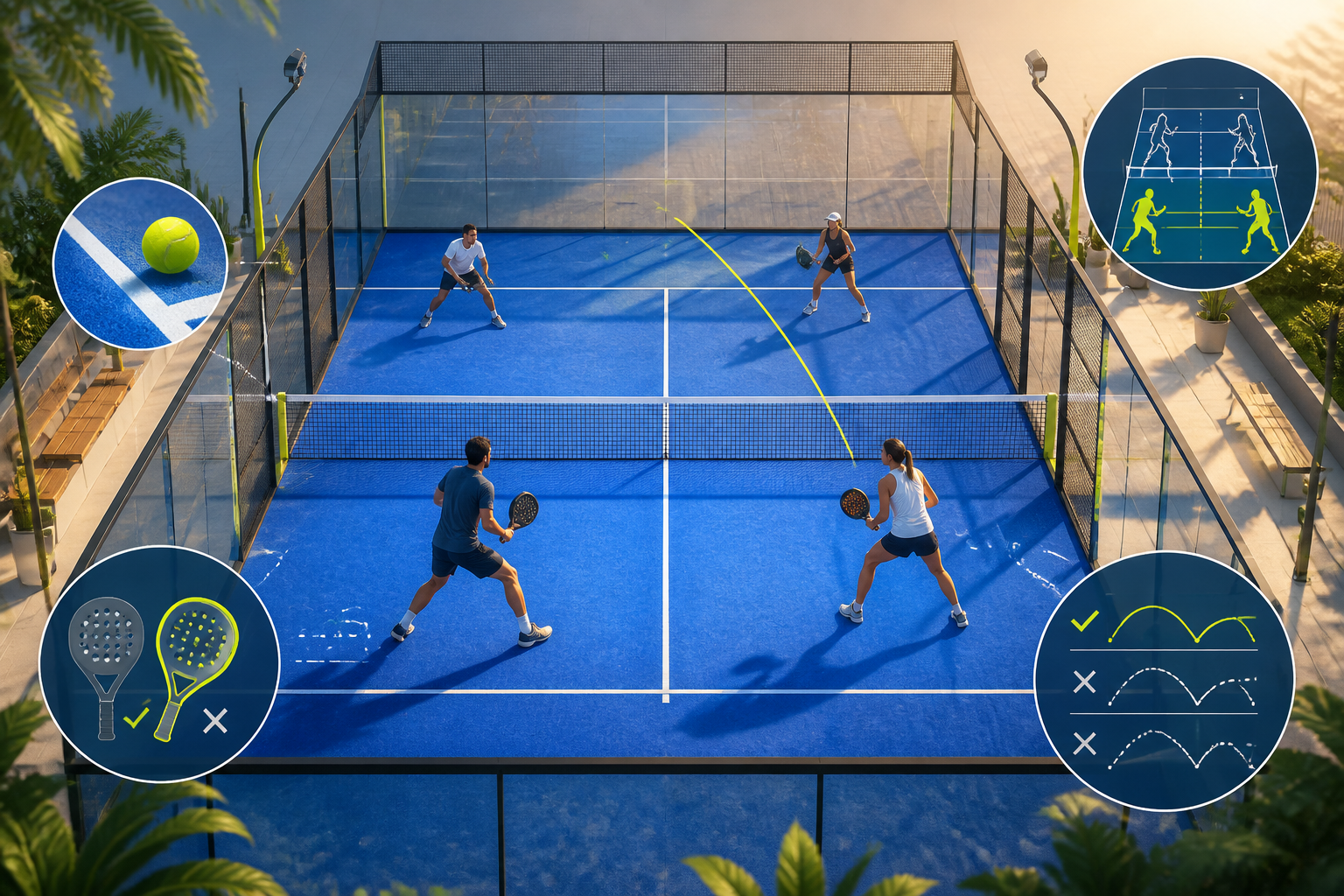
Whether you’ve just picked up your first Babolat Counter Vertuo or you’re a seasoned league player at a UK club like Stratford Padel Club or Surge, understanding the nuances of the rules is what separates a social hitter from a competitive player. As we move into 2026, the International Padel Federation (FIP) has refined several aspects of the game to keep pace with the sport’s blistering speed.
In this guide, we’ll break down the scoring system, the technicalities of the service, and the often-misunderstood rules regarding the cage and glass.
The Foundation: Scoring and the "Golden Point"
Padel borrows its basic scoring structure from tennis: 15, 30, 40, and Game. Matches are typically played as the best of three sets, with each set consisting of six games. However, in 2026, the "Golden Point" (Punto de Oro) has become the standard for both professional tours and high-level UK amateur tournaments.
* Deuce vs. Golden Point: When the score reaches 40-40, there is no "Advantage." Instead, a single deciding point is played.
* The Choice: The receiving team chooses which side (Deuce or Advantage) the serve will be delivered to.
* The Stake: Whoever wins that point wins the game.
Pro Tip: Tactical awareness is key during a Golden Point. I always advise my students to target the weaker volleyer under pressure. If you’re wielding a control-heavy racket like the Nox ML10 Pro Cup, use that precision to force a difficult low volley rather than going for a high-risk winner.
The Serve: Technique and Restrictions
The serve is the only part of padel where you have total control, yet it’s where many beginners lose points due to technicalities. Under current 2026 regulations, the mechanics remain strict:
1. The Bounce: You must bounce the ball behind the service line and within the extension of the center line.
2. The Contact Point: You must strike the ball at or below waist height. If you’re tall and using a powerful Wilson Bela Pro, be careful—the temptation to "slap" the ball from the chest is high, but it will be called a fault.
3. Feet Position: Both feet must be behind the service line at the moment of impact.
4. The Direction: The ball must travel diagonally into the opponent's service box.
What Happens After the Bounce?
If the served ball clears the net, bounces in the box, and then hits the side wire fence, it is a fault. However, if it bounces in the box and hits the glass, it is a legal serve.
Interaction with the Walls and Fence
This is the "Padel IQ" section. Understanding what is "in" and what is "out" when the glass is involved is crucial.
The Direct Hit: If you hit the ball and it strikes the opponent’s glass or fence before* touching the turf, the ball is out.
* The "Clean" Bounce: The ball must always hit the artificial grass first. Once it bounces once, it can hit any number of walls (glass or fence) and remain in play until it bounces a second time on the turf.
* Returning off the Glass: You are allowed to hit the ball against your own glass walls to get it over the net to the opponent’s side. However, you are not allowed to hit it back off your own wire fence.
The "Net Post" and Out-of-Court Play
As the standard of UK padel rises, more courts are being built with the "Professional" specification, allowing for out-of-court play.
* The Net: If the ball hits the top of the net and lands in the correct area, it’s in play (unless it’s a serve, which results in a "let").
* The Posts: The net posts are considered part of the net. However, in 2026, if a ball hits the net tensioning system and bounces back into play, the point continues.
* Exits (Por Tres/Por Cuatro): If an opponent smashes the ball so hard it bounces on your side and goes over the 4-metre back wall (a "Por Cuatro"), the point is over instantly. If it goes out the side door (a "Por Tres"), you can run out of the court to hit it back, provided the court allows for "Off-Court Play."
Equipment Note: To successfully execute a "Por Tres," you need a racket with a high balance and a carbon fibre face, like the Bullpadel Vertex 04. The extra "pop" helps the ball climb the glass.
Position and Etiquette on the UK Circuit
Padel is a gentleman’s (and gentlewoman’s) sport. On the UK LTA Padel Tour, etiquette is as important as the rules:
* The Tap: It is customary to touch rackets with your partner after every point.
* The Shout: Communicating "Mine!" or "Yours!" is essential. In 2026, many UK referees are becoming stricter about "hindrance"—if you shout specifically to distract the opponent as they are hitting, you may lose the point.
* Warm-ups: Official rules dictate a 5-minute warm-up. Don't spend the whole time smashing; use it to gauge the "liveliness" of the balls (usually Head Pro S or Adidas Speed RX in the UK) and how much they are sliding off the back glass.
Common Rule Myths Debunked
1. "The ball hit the fence after the bounce, it's out!" – Incorrect. On a regular rally, if the ball bounces on the turf and then hits the fence, it is perfectly legal. This only counts as a fault during a serve.
2. "You can't touch the net." – Correct. If any part of your body, clothes, or racket touches the net while the ball is in play, you lose the point.
3. "The ball can bounce twice if the second bounce is on the glass." – Incorrect. Once the ball touches the ground a second time, the point is dead, regardless of whether it hit the glass in between.
Summary Checklist for Match Day
Before you step onto the court for your next club championship or friendly at Padel Social Club, run through this mental checklist:
* Racket Check: Is your overgrip fresh? A slipping Head racket can lead to a net touch and a lost point.
* Ball Check: Are you playing with pressurized balls? Padel balls lose pressure faster than tennis balls; playing with "dead" balls ruins the tactical element of the glass.
* The "No-Man's Land": Remember that you shouldn't be standing in the middle of the court. You are either at the net (attacking) or behind the service line (defending).
Padel is a game of geometry and patience. While the 2026 rules provide the framework, the "spirit" of the game is about long rallies and tactical construction. Whether you're playing with an entry-level Adidas Drive or the latest Babolat Technical Viper, respect the lines, embrace the Golden Point, and most importantly, use those walls to your advantage!
By PadelHub Editors · 04/06/2026