
Padel Fitness: Conditioning, Mobility and Injury Prevention
Master the court with this guide to padel-specific conditioning, mobility drills, and essential injury prevention strategies to keep you playing at your peak.
The explosion of padel across the UK, from the industrial parks of Manchester to the posh hubs of West London, has brought a surge of enthusiasm—and, unfortunately, an equal surge in physio appointments. Unlike tennis, which relies on long-form endurance and linear movement, padel is a game of explosive bursts, constant multi-directional twisting, and high-repetition overhead actions. To transition from a "weekend warrior" to a competitive club player, you cannot rely on court time alone. True performance on the carpet requires a dedicated approach to conditioning, mobility, and injury prevention tailored specifically to the unique biomechanics of the sport.
The Padel Physiological Profile: Why It’s Different
A typical padel point lasts longer than a tennis point but involves more frequent changes of direction. You are constantly moving in a "low-to-high" plane—dropping into deep volleys and springing up for bandejas. This places immense strain on the patellar tendon, the Achilles, and the lower lumbar spine.
To train for padel, you must prioritise lateral stability and rotational power. While a heavy carbon-fibre racket like the Babolat Technical Viper or the Nox AT10 Genius provides the tools for power, your body provides the engine. If your engine is misaligned, even the most expensive kit won’t save your game.
Conditioning: Building the Padel Engine
Conditioning for padel should focus on anaerobic capacity—the ability to perform at high intensity and recover quickly during the 20-second rest between points.
* Interval Training over Long Distance: Forget 10k jogs. Opt for Shuttle Runs (suicides) on a 10-metre scale to mimic the dimensions of one side of the court.
* Plyometrics: Box jumps and lateral bounds (skater jumps) are essential. They build the "pop" needed to reach a drop shot or adjust for a tricky rebound off the glass.
* The "Padel Lunge": Most points are won or lost in the transition. Practice weighted lunges (forward, lateral, and reverse) to strengthen the quads and glutes. This ensures that when you’re digging out a low ball with your Bullpadel Hack 03, your legs are doing the work, not your lower back.
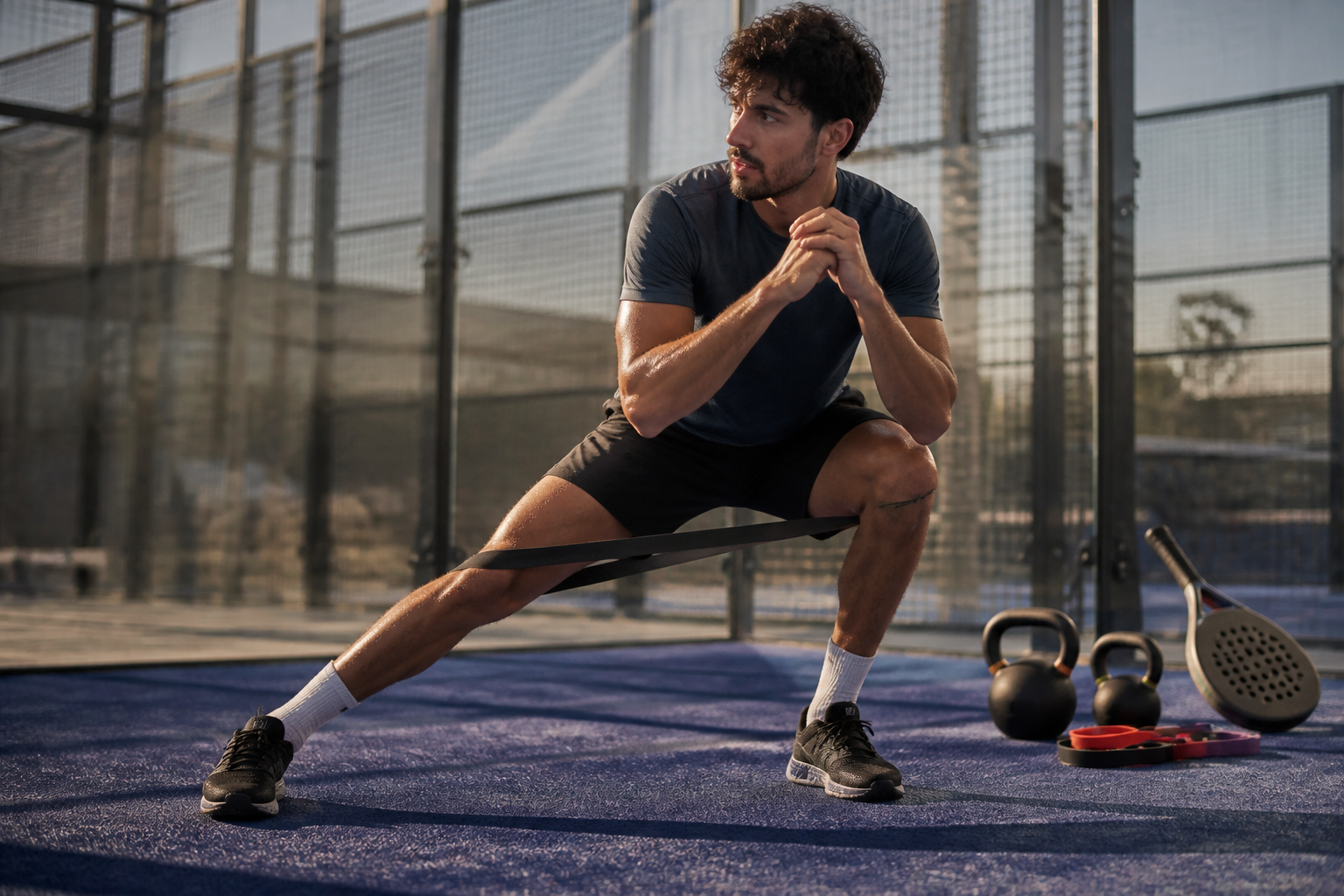
Pro Tip: Use a resistance band around your knees during lateral shuffles to activate the gluteus medius—the key muscle for preventing "valgus collapse" (knee caving), a common cause of ACL injuries on the court.
Mobility: The Secret to High-Level Defense
In the UK, many players come to padel from squash or tennis, bringing with them "tight" movement patterns. Mobility in padel isn't about being a yogi; it's about functional range of motion in three specific areas: the ankles, the hips, and the thoracic spine.
* Ankle Dorsiflexion: If your ankles are stiff, your knees will take the impact. Use a foam roller on your calves before every session.
* Hip Internal/External Rotation: Essential for those quick turns at the back of the court. The "90/90 stretch" is the gold standard here.
Thoracic (T-Spine) Rotation: Padel is a rotational sport. If your mid-back is locked up, your shoulder will overcompensate during the vibora*, leading to rotator cuff issues. Incorporate "thread the needle" stretches into your warm-up.
Injury Prevention: Protecting the "Padel Three"
Data from UK clinics suggests three injuries dominate the scene: Epicondylitis (Padel Elbow), Calf Tears, and Rotator Cuff strains.
1. Padel Elbow (Lateral Epicondylitis)
This is often caused by a combination of poor technique (leading with the elbow on the backhand) and equipment mismatch. If you suffer from vibrations, move away from "Pro" or "Power" rackets with high-density EVA foam. Instead, look for rackets with integrated vibration dampening, such as the Wilson Bela LT or the Head Delta series with Auxetic technology. Using a Hesacore Grip can also significantly reduce the transmission of shock to the forearm.
2. The "Pop" (Calf and Achilles)
The UK’s cooler climate means muscles take longer to reach optimal temperature. Jumping straight onto the court at 7:00 PM in February is a recipe for a calf tear.
* The Warm-up: Spend 10 minutes on a dynamic warm-up. High knees, leg swings, and "zombie walks."
* Footwear: Stop playing in running shoes. Running shoes have a high stack height and zero lateral support, making ankle rolls inevitable. Invest in padel-specific shoes like the Adidas Ubersonic or Asics Solution Swift, which are designed for the specific grip requirements of Mondo STX grass (the blue turf common in UK clubs like Padel Social Club or We Are Padel).
3. Shoulder Maintenance
The Bandeja and Smash are overhead movements that put the shoulder in a vulnerable position.
* Prehab: Use light resistance bands for external rotations and "Face Pulls" twice a week.
* Technique: Avoid "clutching" the racket too hard. A relaxed grip—only tightening at the moment of impact—saves the small stabilising muscles of the shoulder from chronic fatigue.
Nutrition and Recovery in the UK Context
The UK padel scene is social, often revolving around a post-match drink. However, recovery starts the moment the match ends.
* Hydration: Padel courts (especially indoor converted warehouses) can become incredibly humid. Electrolyte tabs are superior to plain water for maintaining muscle function and preventing cramps during a long three-setter.
* Temperature Control: After a high-intensity session, your core temperature drops quickly in the British climate. Put on a technical mid-layer (brands like Nike or Castore dominate the UK scene) immediately after playing to keep the muscles warm while you stretch.
* The 24-Hour Rule: If you are over 40, avoid playing high-intensity matches on consecutive days. Padel’s eccentric loading (the braking movement) causes micro-tears in the muscle that need 48 hours to repair fully.
The "Padel-Ready" Weekly Schedule
For the committed amateur, a balanced week looks like this:
* Monday: Padel Match/Lesson.
* Tuesday: Strength & Mobility (Focus: Core, Glutes, Rotator Cuff).
* Wednesday: Rest or light walking.
* Thursday: Padel Match/Drills.
* Friday: HIIT / Shuttle runs (30 mins).
* Saturday: Competitive Match.
* Sunday: Active recovery (Yoga or swimming).
Summary
Padel is an addictive, high-speed game that rewards agility and finesse more than raw strength. By treating your body with the same respect you give your Babolat or Head racket, you will not only play better but play longer. Focus on your "low-to-high" strength, maintain your T-spine mobility, and never skip the dynamic warm-up. The goal isn't just to win the next point—it's to ensure you're still on the court winning points for decades to come.
Stay supple, stay explosive, and we’ll see you at the back of the court.
By PadelHub Editors · 04/06/2026