
Padel Court Positioning 101: Owning the Net
Master the net and dominate the transition zone with these essential positioning secrets to outsmart your opponents and control every Padel point.
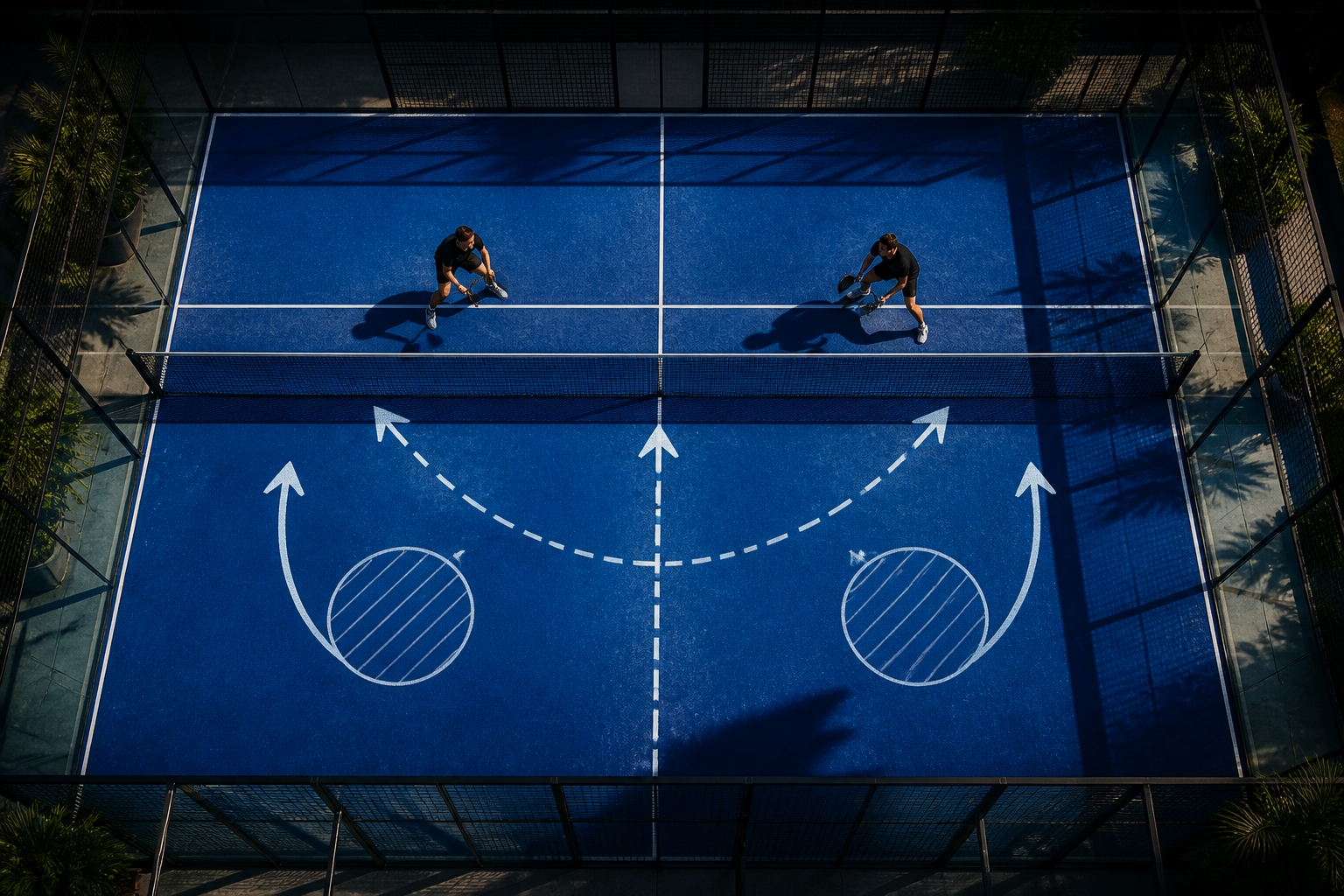
If you’ve spent any time watching professional World Padel Tour or Premier Padel matches, you’ll notice a recurring pattern: the team that controls the net controls the score. In Padel, the baseline is your shield, but the net is your sword. For many UK players transitioning from tennis or squash, the instinct is often to retreat when under pressure. However, in the 20x10 metre cage, "owning the net" is as much about psychological dominance as it is about technical execution.
Mastering court positioning at the net isn't just about standing close to the mesh; it’s about understanding the "neutral zone," managing the transition, and knowing when to use your equipment—be it a high-balance Bullpadel Vertex or a control-oriented Adidas Adipower—to punish your opponents. Here is your definitive guide to dominating the front of the court.
The "Golden Rule" of Net Positioning
Too many club players in the UK stand either too close to the net (leaving them vulnerable to the lob) or in "no man's land" (halfway between the service line and the net).
The ideal position is approximately 2 to 3 metres back from the net. Standing here allows you to:
* Reach most volleys comfortably without overstretching.
* Have enough reaction time to handle body shots.
Be in a prime position to move backward for a Bandeja or Vibora* if the opponent lobs.
If you are using a racket with a large sweet spot, such as the Head Gravity Elite, you have a little more margin for error on off-centre volleys while holding this line.
The Transition: Moving as a Unit
Padel is a game of pairs. One of the most common mistakes seen at UK padel centres is the "staggered" formation, where one player is at the net and the other is stuck at the back. This creates a gaping diagonal hole that experienced players will exploit.
You must move like you are connected by an invisible two-metre rope. When your partner is pushed back by a lob, you should also retreat slightly to cover the middle. When you see a short ball and your partner moves in, you must follow. This "pendulum" movement ensures that the "T" (the centre of the court) is always protected.
Managing the Lob: The Bandeja vs. The Smash
In the UK, where many courts are indoors or under seasonal canopies, the height of the ceiling can dictate your net strategy. On a high-ceiling court, opponents will lob frequently. Your job at the net is to ensure they don't "win back" the position.
* The Bandeja: This is your defensive volley. When a lob is deep but not quite a smash opportunity, you use the Bandeja to maintain your net position. Equipment like the Nox ML10 Pro Cup is legendary for this shot because its round shape and low balance provide the control needed to keep the ball deep and low.
The Smash: If the lob is short, it’s time to finish the point. If you play with a diamond-shaped power racket like the Babolat Technical Viper, this is your moment. Remember: at the net, a smash should either be brought back to your side (the X3*) or hit with enough kick to bounce over the 4-metre fence.
Specific Drills to Own the Net
To truly own the net, your footwork must be "active." You should never be flat-footed. Here are three drills we recommend at PadelHub UK:
1. The Shadow Volley: Stand in your net position. Have a partner feed you 10 rapid volleys. Your goal isn't just to hit them back, but to recover your "home base" position after every single shot.
2. The Box Drill: Place four cones in a square (2m x 2m) at the net. Move laterally to volley, then diagonally back to simulate a Bandeja, then forward again. This builds the explosive "V" movement required for high-level play.
3. The "Two-Touch" Game: Play a practice set where you are only allowed to win the point from the net. If you are forced back to the baseline, you must find a way (typically a lob) to get back to the net immediately.
Equipment Tailored for Net Domination
Your choice of racket significantly impacts your ability to hold the net. While skill is paramount, the right gear acts as an extension of your intent.
* For Fast Hands: If you find you’re getting beaten by fast shots at the body, a lighter racket like the Wilson Bela LT offers the manoeuvrability needed for "reflex volleys."
* For Putting the Ball Away: If your net game is built on aggression, the Adidas Metalbone 3.3 (favoured by Ale Galán) provides the stiffness required to punch volleys through the court.
* For Stability: A racket with a 12K or 18K carbon face, often found in the Nox Luxury Series, provides the stability needed to block heavy shots from opponents without the racket twisting in your hand.
Reading the Opponent’s Shoulders
Expert net play isn't just about where you stand; it’s about "reading the play." Before the opponent even hits the ball, their body language tells you where it’s going:
* Dropped Shoulder: They are likely going for a lob. Start shifting your weight back.
* Fast Backswing: Prepare for a "Bajada" or a hard drive down the middle. Close the gap at the net slightly and tighten your grip.
* Compact Swing: Expect a "Chiquita" (a soft ball at your feet). Be ready to move forward and "scoop" the volley before it drops below the net cord.
The Psychological Edge
Lastly, owning the net is about presence. In the UK circuit, players often respect opponents who "clover" the net aggressively. By staying tight and moving forward on every weak return, you force your opponents to attempt higher-risk shots, leading to unforced errors.
If you look at the top tier of UK Padel, the winners are rarely the ones with the flashiest groundstrokes; they are the ones who refuse to be moved from the net. Wear the right shoes—like the Asics Gel-Padel Exclusive or Babolat Jet Premura—to ensure your lateral grip is perfect, and make the net your home.
Summary Checklist for Your Next Match:
* Position: 2-3 metres from the net.
* Movement: Synchronised with your partner (the invisible rope).
* Shot Selection: Use the Bandeja to hold the net, the Smash to end it.
* Vision: Watch the opponent's shoulders, not just the ball.
By implementing these positioning fundamentals, you'll find that the game slows down, your options increase, and your win rate at your local club will inevitably climb. See you on the court!
By PadelHub Editors · 04/06/2026