How to Choose Your First Padel Racket: A Complete Beginner's Guide
Stop wasting money on the wrong gear: Master the shapes, weights, and materials to find your perfect first padel racket and dominate the court from day one.
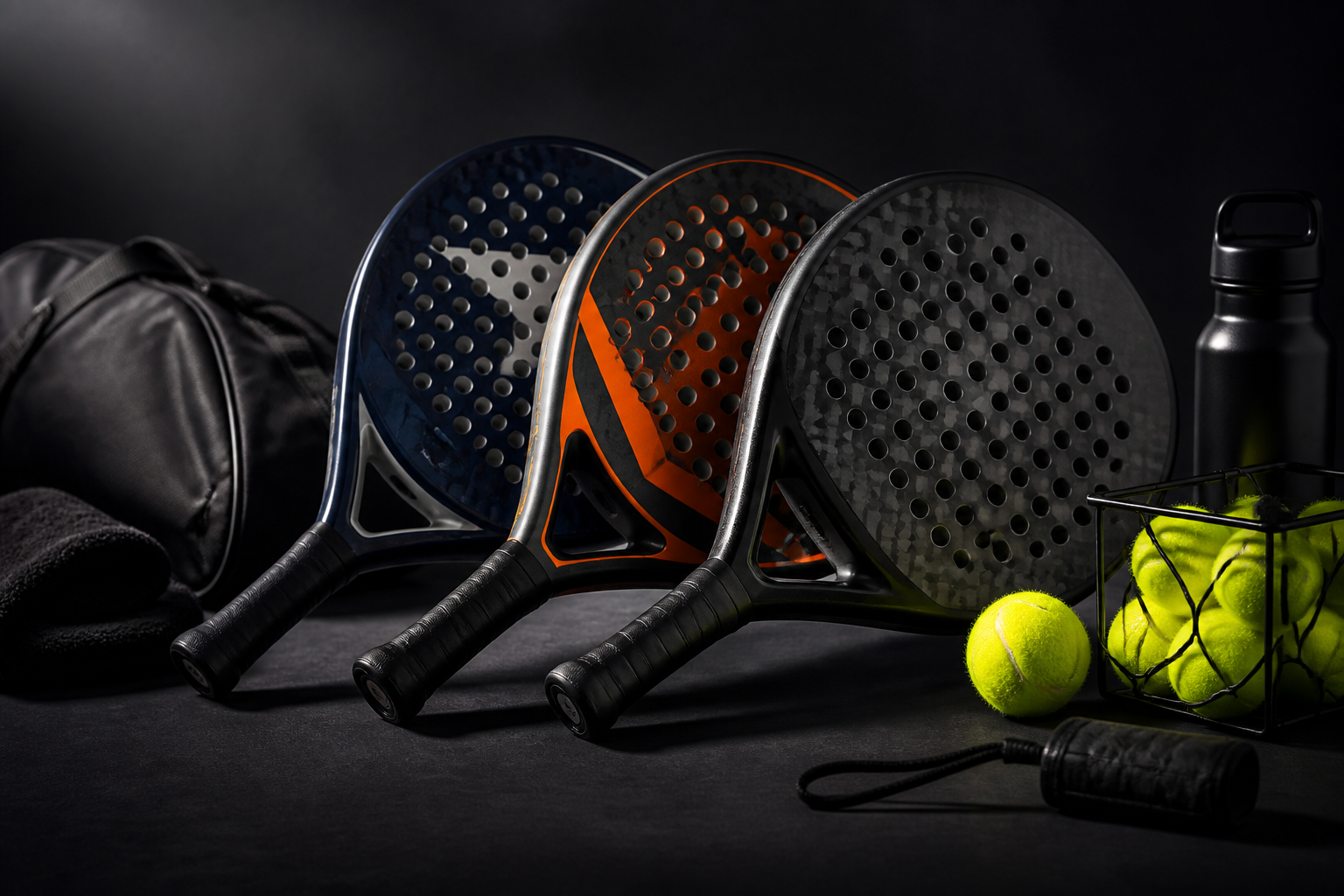
So, you’ve caught the bug. Maybe you’ve spent a few weekends at a Stratford Padel Club social, or perhaps you’ve just discovered the local courts popping up in Bristol or Manchester. Padel is the fastest-growing sport in the UK for a reason: it’s social, fast-paced, and incredibly addictive.
However, the transition from renting a battered, chipped club racket to owning your first piece of "weaponry" can be daunting. Walk into any specialist shop or browse online, and you’re met with a bewildering array of shapes, weights, and "carbon technologies." Choosing the wrong racket isn’t just a waste of £100; it can actively hinder your progress or, worse, lead to "padel elbow."
As a senior coach, I’ve seen hundreds of beginners make the same mistake: buying a racket because their favourite World Padel Tour pro uses it. This guide is designed to strip away the marketing fluff and help you find a racket that actually helps you enjoy the game.
1. The Golden Rule: Prioritise Control Over Power
If there is one piece of advice I hammer home to my students at PadelHub, it’s this: In padel, the walls are your friends, but the net is your enemy.
As a beginner, you don't need a racket that hits the ball out of the park (a "smash"). You need a racket that helps you keep the ball in play, find the corners, and manage the rebound off the glass. High-power rackets are often stiff and "unreliable" in the hands of a novice. Your first racket should feel like an extension of your arm, offering a large "sweet spot" so that even off-centre hits travel over the net.
2. Understanding Racket Shapes
Padel rackets come in three primary shapes. For a beginner, the choice is almost always clear-cut.
* Round Shape (The Beginner’s Best Friend): These rackets have a weight balance closer to the handle. This makes them feel light and easy to manoeuvre. Crucially, the sweet spot is right in the centre and very wide. If you are starting out, start here.
* Teardrop Shape (The All-Rounder): A hybrid between power and control. If you have a background in tennis or squash and already have good "hand-eye" coordination, a teardrop might be a good "bridge" racket.
* Diamond Shape (The Pro’s Choice - Avoid for now): These are top-heavy and designed for power. Brands like Babolat (with their Technical Viper line) or Bullpadel (the Vertex 03) make incredible diamond rackets, but for a beginner, they are unforgiving and can lead to wrist strain.
3. Materials Matter: Foam vs. Carbon
What’s inside the racket is just as important as the shape. You will generally see two types of internal cores:
* FOAM (Polyethylene): This is softer and provides excellent vibration absorption. It’s "springy," meaning the ball flies off the racket with little effort. This is brilliant for beginners who haven't developed full swing strength yet.
* EVA Rubber: Most modern rackets use EVA. For your first racket, look for "Soft EVA" or "Ultra Soft" labels. Brands like Nox are famous for their "HR3" core which offers a great balance. You want to avoid "Hard EVA" for at least the first six months of playing.
Face Material: Look for Fibreglass on the face (the hitting surface) rather than 12K or 18K Carbon. Fibreglass is more flexible and "elastic," making it much easier to control the depth of your shots.
4. Weight and Manoeuvrability
In the UK, we often play in slightly cooler, damper conditions than in Spain. A ball that is heavy with moisture requires a racket you can move quickly.
* Standard weight for men: 360g – 375g.
* Standard weight for women: 340g – 360g.
As a beginner, lean toward the lower end of these scales. A lighter racket (around 350-355g) allows you to react faster at the net during quick volleys. Wilson and Head offer excellent "Light" versions of their popular models specifically for this purpose.
5. Top Brand Recommendations for Beginners
While you can find "no-name" rackets on Amazon, I strongly recommend sticking to established padel brands. Their entry-level rackets benefit from the R&D of their premium lines.
* Nox (The ML10 Pro Cup): This is a legendary racket. Designed by Miguel Lamperti, it is round, uses fibreglass, and is perhaps the most recommended "first serious racket" in the world. It’s a "buy once, keep for two years" type of gear.
Adidas (Drive or Match Series): Adidas has a very clear hierarchy. Their Drive* range is specifically built for those in their first ten lessons. They are affordable and very forgiving.
Bullpadel (Indiga Control): The Indiga* range is designed for the recreational player. It’s incredibly light and has a very large hitting surface.
Head (Evo Sanyo or Zephyr): Head rackets often have a unique "teardrop-round" hybrid shape that offers a bit more longevity as you improve. The Zephyr* is particularly well-regarded for being "soft" on the arm.
* Babolat (Contact or Reveal): If you want something that feels effortless to swing, Babolat’s entry-level models are some of the lightest on the market.
6. Practical Tips for the UK Player
* The Overgrip Secret: Almost every padel racket comes with a grip that is too thin for the average adult hand. Always buy a pack of "Overgrips" (Wilson Sensation or Hesacore are popular). Adding one or two overgrips prevents you from gripping the racket too tightly, which is the leading cause of "Padel Elbow."
* Don't forget the Protector: British courts often have metal mesh fencing. A "Protector Tape" (a clear adhesive strip on the top of the frame) will save your racket from cracks when you’re digging out those low balls near the fence.
* The "Demo" Rule: If your local club has a pro shop, never buy without trying. Most UK clubs (like Rocket Padel or Padeler) allow you to rent a demo racket for £5. Spend a session with a Round racket and a Teardrop racket to see which feels more "natural" to your swing.
7. When Should You Upgrade?
Your first racket should last you 6 to 12 months. You’ll know it’s time to move on when you feel the racket is "bottoming out"—meaning you are swinging hard but the racket isn't providing the "zip" or "crunch" you need to finish points.
Until then, focus on your footwork and your "bandeja." A £300 racket won't fix a bad swing, but a £80-£120 beginner racket from a reputable brand will give you the perfect foundation to fall in love with this game.
Final Expert Verdict: If you are truly stuck, look for a Round shape, Fibreglass face, and a weight under 365g. See you on the court!
By PadelHub Editors · 04/06/2026